This page was last updated in 2023 and may contain language which is now outdated.
Slowly emerging from isolation
Immediately identifiable by their long lip plugs, the Zo’é first met outsiders in 1982, when evangelical missionaries made contact. Decimated by disease soon after, their numbers are now growing again.
A peaceful way of life
The Zo’é are a small, isolated tribe living deep in the Amazon rainforests of north Brazil. They only came into sustained contact with outsiders in 1987 when missionaries of the New Tribes Mission built a base on their land.
Their land has been officially recognized by the government, which controls access to it to minimise the transmission of potentially fatal diseases such as flu and measles.
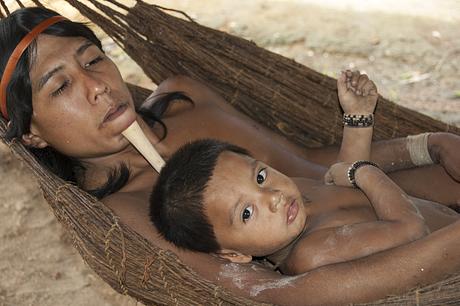
The Zo’é live in large rectangular thatched houses which are open on all sides. Here several families live together, sleeping in hammocks slung from the rafters and cooking over open fires along the sides.
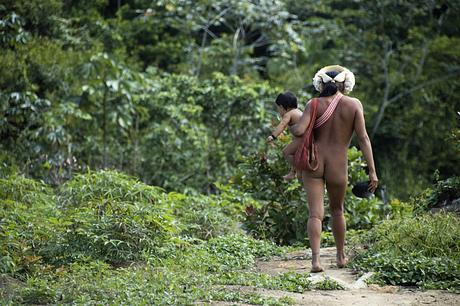
The Zo’é prize Brazil nuts, and often site their communities in groves of Brazil nut trees. As well as providing a rich source of food, the nut shells are fashioned into bracelets, and the shell fibre is used to make hammocks.
Zo’é communities are surrounded by large gardens where manioc and other tubers, peppers, bananas and many other fruits and vegetables are grown. Cotton is cultivated and used to make body ornaments and hammocks, to bind arrow heads and to weave slings for carrying babies.
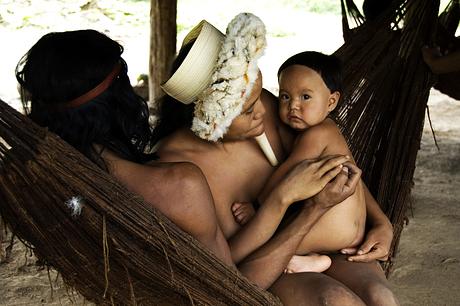
The Zo’é are polygamous, and both men and women may have more than one partner. It is fairly common for a woman with several daughters to marry several men, some of whom may later marry one of her daughters.
Everyone is equal in Zo’é society. There are no leaders, though the opinions of particularly articulate men, known as ‘yü’, carry more weight than others in questions of marriage, opening up old gardens or establishing new communities.
The men are extremely skilled hunters. Hunting is usually done individually, but at certain times of the year – ‘fat monkey time’ or ‘king vulture time’ – collective hunts are organised.
When large bands of peccaries mass together Zo’é men hunt together, running furiously after the peccaries firing arrows, while the women catch the startled babies, which are taken back home and raised as pets or ‘raimbé’. The Zo’é also fish using harpoons and timbó – a fish poison made from crushed vines.
Body decoration and rituals
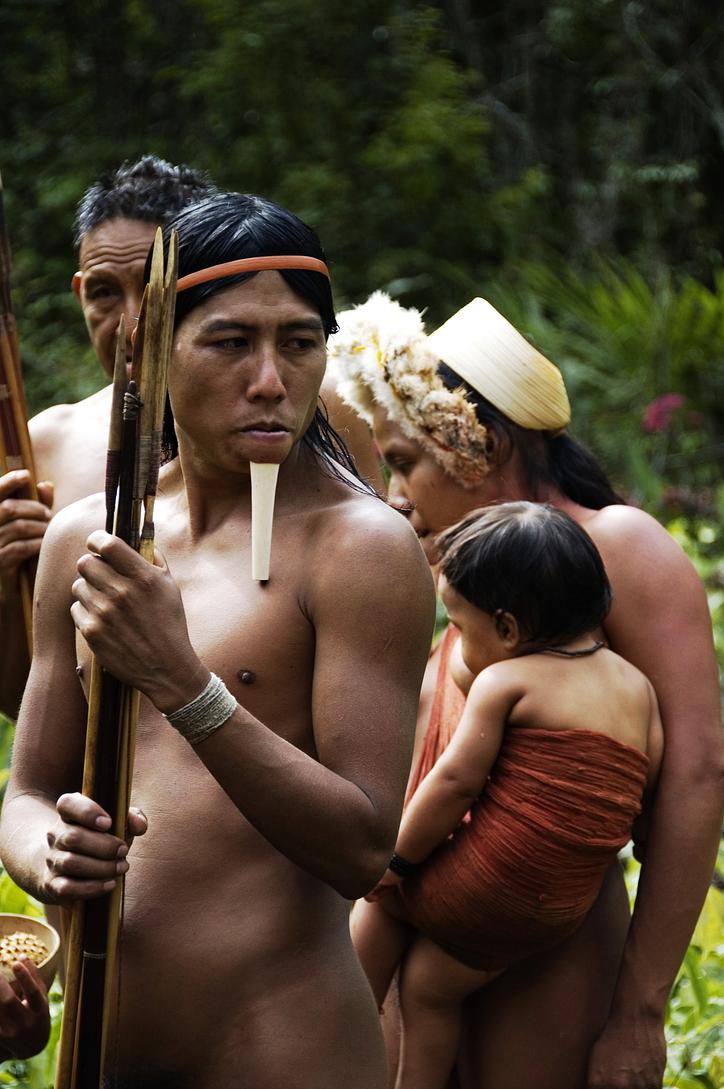
From a young age all Zo’é wear the ‘m’berpót’ – the long wooden plug inserted into the lower lip.
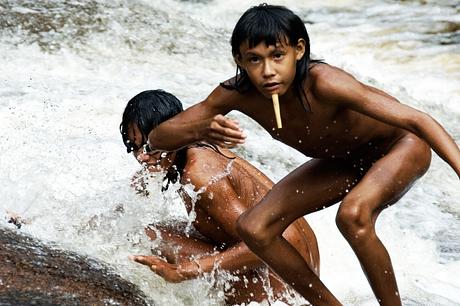
The Zo’é tell how an ancestor called Sihié’abyr showed them how to use the lip plug. One of the most important ceremonies, and a rite of passage for children, is the piercing of the lower lip.
A sharp bone from a spider monkey’s leg is used, and a tiny ‘m’berpót’ is inserted, usually when girls are about seven and boys about nine years old. As they grow older, larger plugs are inserted.
Women wear elaborate headdresses made from the soft white breast feathers of the king vulture, and paint their bodies with urucum – a vibrant red paste made from crushing annatto seeds.
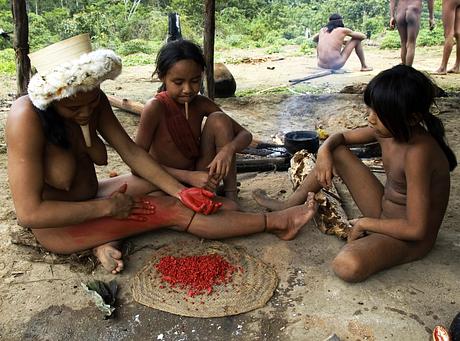
Rituals mark many aspects of Zo’é life such as birth and death, girls’ first menstruation, and the first tapir hunted by adolescent boys.
Seh’py is perhaps the greatest collective ceremony, which can be performed to mark any important event. It is named after the naturally fermented drink served during the ritual, which is made from any tuber in season at the time. The men dress in long fibre skirts called ‘sy’pi’. Men and women dance together all night in a series of unique dances accompanied by singing. At dawn the men finish the drink and expel it by vomiting together.
Uncertain future
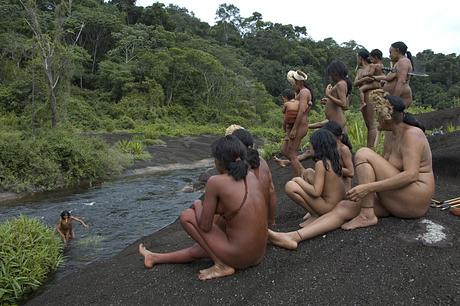
Like many tribal peoples who have recently come into contact with national society, life is changing for the Zo’é. Some people have accused FUNAI, the government’s Indian affairs department, of keeping them in a ‘bubble’, with few people allowed in to their territory, and Zo’é discouraged from going out.
But this policy has undoubtedly saved lives, and the Zo’é population has stabilized, is generally healthy and now growing.
However, the Zo’é are curious about their neighbours and the world beyond their borders, and have expressed their desire to learn more about the world outside.
In February 2011, for the first time, a group of Zo’é travelled to Brazil’s capital Brasilia, to put their demands to the authorities. These include an education project, training of Zo’é as health workers, and a land protection programme in which the Indians themselves can actively participate.
The challenge now for the Zo’é is to learn about their rights and understand Brazilian society so that they can interact on an equal footing with it, without succumbing to common diseases like flu to which they are still extremely vulnerable.
Pressure on their territory and its rich natural resources is mounting: nut gatherers, gold miners and missionaries periodically invade their land, and the soya and cattle ranching frontier is getting ever closer. Large-scale mining companies are also interested in mining around the Zo’é’s territory.
First contact
The Zo’é have lived quietly in the thick forest between the Erepecuru and Cuminapanema rivers since time immemorial.
In the 1940s and 50s men hunting jaguars and other wild cats for their skins first disturbed the peace of the forest. Then gold panners and Brazil nut collectors started to venture in.
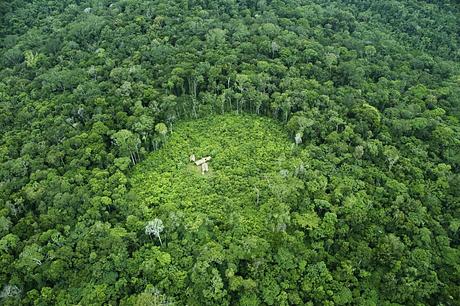
The Zo’é had fleeting encounters with these people, but were not disturbed until, in 1975, a mineral survey plane flying over the forest spotted one of their communities. The surveyors returned to throw goods out of the plane – and later reported that the Zo’é had stamped on the objects and buried them.
Gradually, the Zo’é’s existence became known to Brazil’s missionary community. Between 1982 and 1985 the New Tribes Mission made various expeditions into the Zo’é’s territory, making fleeting contact with one small group, and overflying communities to drop ‘presents’ from the plane. In 1987 the New Tribes Mission established a base and airstrip on the edge of the territory.
According to the missionaries the first definitive contact with the Zo’é was on 5 November 1987. For some days before, groups of Zo’é had been secretly observing the missionaries at their base. Years later a Zo’é hunter recalled how amused they were at the missionaries’ hunting techniques, noting how they did not move swiftly through the forest and how one carried a peccary on his back with ‘its head lolling around and its jaws making a clacking sound’.
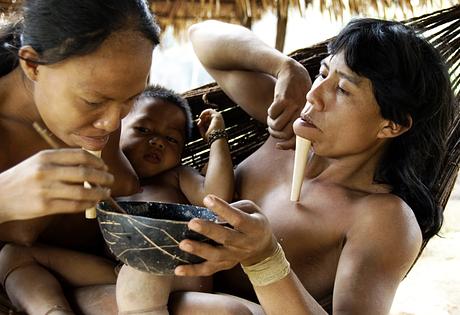
Finally some Zo’é came in to the mission base camp and exchanged broken arrowheads for goods from the missionaries. Gradually more Zo’é arrived and built homes near the base, attracted by the availability of useful tools such as machetes, knives, pans and fishing tackle.
Tragedy soon struck. The Zo’é started to fall ill from diseases to which they had no immunity. With so many Zo’é in one spot, flu and malaria spread rapidly. As the situation deteriorated the missionaries contacted the government Indian affairs department, FUNAI, which sent in medical teams. The epidemics devastated the tribe – about one quarter of the Zo’é’s original population died between 1982 and 1988.
Reacting to the catastrophe, FUNAI expelled the missionaries in 1991 and started a process of trying to persuade the Zo’é to return to their old villages.
FUNAI has now built a state-of-the-art base complete with mini-hospital to treat any Zo’é who fall sick, to avoid the need to transfer them to the nearest city for treatment. Any outsider visiting the Zo’é is thoroughly screened before they can enter the territory. As a result the population has stabilized and is gradually increasing. Today there are about 250 Zo’é.
Mounting threat
The Zo’é are still a very vulnerable tribe. Their population is small and they are extremely susceptible to many common diseases against which they have not had time to build up immunity.
Until now, their territory has been relatively free from invasion, and in 2009 it was officially ‘ratified’ by the government for their exclusive occupation and use.
However, there is mounting pressure on Zo’é land from hunters and miners, and from hundreds of nut collectors targeting the rich stands of Brazil nut trees. Evangelical missionaries are also attempting to enter. Any incursion by outsiders would pose enormous risks to the health of such an isolated tribe.
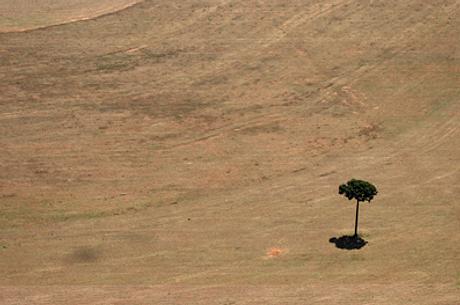
The soya and cattle-ranching frontier to the south of the Zo’é territory is moving steadily northwards, and there are fears that it will be difficult to keep farmers out of this large territory unless a rigorous land protection program is in place.
 © Rodrigo Baleia/Survival
The Zo’é themselves are curious, and wish to see and understand the world beyond their frontiers. In February 2011, for the first time a group of Zo’é travelled to Brazil’s capital Brasilia to meet with various government bodies.
They discussed their concerns about the pressures on their forest and made clear that they wish to actively participate in a program to protect it. They also expressed their desire for an education program suitable for their needs, and for a program to train Zo’é to become health agents.
The challenge is to enable and help the Zo’é to understand and interact equally with the outside world, without compromising their health or land.
Act now to support the Zo’é
Join the mailing list
There are more than 476 million Indigenous people living in more than 90 countries around the world. To Indigenous peoples, land is life. Find out more about them and the struggles they’re facing: sign up to our mailing list for occasional updates.